A Tree That Bears Much Fruit
Johan Malan, Mossel Bay, South Africa (September 2014)
Scripture reading: A man whose delight is in the Word of the Lord, “shall be like a tree planted by the rivers of water, that brings forth its fruit in its season, whose leaf also shall not wither; and whatever he does shall prosper” (Ps. 1:3).
“Blessed is the man who trusts in the Lord, and whose hope is the Lord. For he shall be like a tree planted by the waters, which spreads out its roots by the river, and will not fear when heat comes; but its leaf will be green, and will not be anxious in the year of drought, nor will cease from yielding fruit” (Jer. 17:7-8).
|
|
|
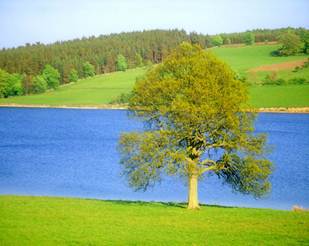

A Christian is likened to a fruit-tree planted by the water. The reason for this tree’s success is very obvious – it is not to be found in any of its own virtues but in the fact that secretly, deep down where no one can see, it spreads out its roots by the stream. That is the reason why droughts, heat and adverse external conditions cannot overcome it. Its leaves are always green and its continued existence certain. That is also the secret of a dedicated Christian – he is like a tree planted by streams of water, which yields its fruit in season and whose leaf does not wither.
The stream of water refers to the Lord Jesus, to cleansing by His blood, and to His invigorating power which ever flows to us through His Holy Spirit. This water quenches our spiritual thirst, it enables us to bear fruit which befits repentance, and empowers us to prevail against all the attacks that we have to endure. The life and invigoration which we derive from this stream is everlasting. Jesus said to the woman at the well: “[W]hoever drinks of this water will thirst again, but whoever drinks of the water that I shall give him will never thirst. But the water that I shall give him will become in him a fountain of water springing up into everlasting life” (John 4:14).
The grace of Jesus Christ towards salvation is available to anyone who is prepared to accept it by faith. When we become aware of our spiritual thirst we must simply go to Him to be cleansed from our sins, to refresh our souls and to fill us with His Holy Spirit. His invitation is extended to all people: “If anyone thirsts, let him come to Me and drink. He who believes in Me, as the Scripture has said, out of his heart will flow rivers of living water” (John 7:37-38). “But this He spoke concerning the Spirit, whom those believing in Him would receive” (John 7:39). At the end of the book of Revelation He reiterates His offer of free grace: “I will give of the fountain of the water of life freely to him who thirsts” (Rev. 21:6).
Is your life also characterised by the hidden source of power which the grace of Christ provides to you? If so, you will be able to stand firm on your convictions in an agnostic and hostile world. Even if there is a spiritual drought in the world in which thousands of people depart from the faith, you will not be part of the problem. Jeremiah says that the tree which has been planted by the water does not fear when heat comes; its leaves are always green and will not be anxious in the year of drought, nor will cease from yielding fruit (Jer. 17:8).
Nature provides us with a practical illustration of such a life. The shepherd’s tree (Boscia albitrunca) is a protected evergreen tree which grows in large areas of Southern Africa – also in the driest parts of the Kalahari and other semi-desert areas. Despite changing weather conditions this tree is always green, also during the worst droughts. Its secret is that its roots penetrate deep into the ground until it reaches a subterranean watercourse. A Wikipedia article, Boscia albitrunca, says: “A specimen found in the central Kalahari in 1974 had roots extending to 68m deep, making it the plant with the deepest known roots.” When extreme droughts and heat waves occur, leading to the withering and even dying of other trees, the shepherd’s tree remains green. Its branches are often cut so the leaves can serve as fodder for animals when it is very dry and no other grazing is available.
We should also have depth in our spiritual lives, and an unbroken connection with the fountain of living water; then we will never wither away spiritually and become the victims of harsh circumstances. Our faith should be determined by our relationship with the Lord Jesus, and not by external circumstances in the world, or by the changing opinions of other people. That is why Paul could say, even when he was confronted by the most forbidding circumstances: “I have fought the good fight, I have finished the race, I have kept the faith” (2 Tim. 4:7). He did not perish in the struggle, even though he died as a martyr for his faith in Rome. His faith did not diminish but, to the contrary, it was strengthened and he completed the ministry which he received from the Lord. God was his power and strength, and that carried him through every crisis – despite how humanly impossible the challenges appeared to be.
The most important condition for success in our spiritual life is to maintain a close relationship with Jesus Christ. That connection should always be open. Jesus prepared His disciples to stand spiritually firm in a hostile world, and to keep on bearing abundant fruit. The condition for a life of this nature is to abide in Him. He said: “Abide in Me, and I in you. As the branch cannot bear fruit of itself, unless it abides in the vine, neither can you, unless you abide in Me. I am the vine, you are the branches. He who abides in Me, and I in him, bears much fruit; for without Me you can do nothing” (John 15:4-5).
The fruit of the Spirit
The metaphor of the tree which yields fruit in season fixes our attention on the fact that the Lord expects fruit from our lives. However, that does not refer to human works which we do in our own strength, but to the fruit of the Holy Spirit – i.e. works that He does through us. Before that can happen, our entire personality and character need to be changed by the Holy Spirit, so we can have the correct disposition to please the Lord. When our motives are pure the Lord will work through us and achieve a great purpose with our lives. The propensities and guiding principles which the Lord wishes to instil in our hearts are described as the fruit of the Holy Spirit: “[T]he fruit of the Spirit is love, joy, peace, longsuffering, kindness, goodness, faithfulness, gentleness, self-control” (Gal. 5:22-23).
These principles determine the deepest inclinations of a person’s heart, they shape the values which he pursues and determine his entire way of living as well as the nature of his actions. The nine fruits of the Spirit are clearly divisible into three groups, which reflect the believer’s nature and relationships on three levels of his life. The first three fruits describe the nature of your relationship towards God, the next three determine your relationships with other people, and the last three describe your basic characteristics as a person.
The first three fruits are love, joy and peace. God is love. During and after your rebirth the love of God is poured out in your heart by the Holy Spirit (Rom. 5:5). You are rooted and grounded in it and it becomes part of your whole life. You love the Lord with all your heart because he saved your soul and accepted you as His child. You are no longer in rebellion against Him because of your sin, hence you no longer despise, blaspheme and avoid Him. To the contrary – you desire His presence, sing His praises, honour Him and call upon His Name. There is great joy in your heart for what the Lord Jesus has already done for you when He entered your name into the book of life, and also for what He will still do for you in the ages to come. Under all circumstances, even during times of sorrows and testing, you rejoice in the Lord and look forward to a wonderful future. In your heart there is peace which surpasses all understanding since the Lord Jesus is your peace. He said: “Peace I leave with you, My peace I give to you; not as the world gives do I give to you” (John 14:27). His peace is a deep, inner knowledge that your sins have been forgiven because you are reconciled with God. There is no fear for the future as you will not come into the judgement of the sinners. You also know that no hostile powers, distress, persecution or any other adverse circumstances will ever be able to separate you from the love of God which is in Christ Jesus our Lord (Rom. 8:35-39).
These first three fruits, i.e. love, joy and peace towards God, should also be put into action in your relationships with other people. That is precisely what happens when God’s agape love which reaches out to a lost world, fills your heart and mind and prompts you to bear the fruit of the second group, namely longsuffering, kindness and goodness. You are no longer vindictive and judgemental but longsuffering towards people. You have compassion with them and pray for their salvation, even for many years, without losing faith and writing them off. You are a kind and hospitable person who does not only live for himself, but has time for others and also reach out to them. You demonstrate goodness to people by sharing the gospel with them, and also help to alleviate their physical need as far as possible. Paul says: “And let us not grow weary while doing good, for in due season we shall reap if we do not lose heart. Therefore, as we have opportunity, let us do good to all, especially to those who are of the household of faith” (Gal. 6:9-10).
The third group of fruits, namely faithfulness, gentleness and self-control, are personal characteristics which are developed with the help of the Holy Spirit as well as the practising of self-discipline. You are faithful in all your commitments, above all in your quiet times, and not a careless and disorganised person who neglects his duties. You are also gentle, which means that you are benevolent. You are not harsh and unapproachable, but a meek person who is compassionate towards those who suffer hardships. Gentleness also means that you have a tender heart that does not resist the Word of God. You have a teachable spirit and are open to be admonished by the Word of God and by other people. Lastly, by the grace of God, you also have self-control. That means that you do not act impulsively by doing or saying things for which you later have to apologise. You do not, in a fit of anger, say bad things which originate from your uncrucified flesh, as that is definitely not the fruit of the Spirit. How do people experience you in everyday life? Solomon says: “He who is slow to anger is better than the mighty, and he who rules his spirit than he who takes a city. … He who has knowledge spares his words, and a man of understanding is of a calm spirit” (Prov. 16:32; 17:27). In the New Testament this wonderful disposition, together with the others which are mentioned, are described as the fruit of the Spirit. Only by the grace of God will you be able to show these fruits in your life, and not because of your own attributes, as they are all expressions of the divine nature of Christ with which we must be clothed. “[P]ut on the Lord Jesus Christ” (Rom. 13:14; cf. Gal. 3:27).
Is that a description of your life as a Christian? If not, then confess the fact that you often grieve the Holy Spirit by your thoughts, desires, dispositions, words and actions. Put things straight with the Lord and surrender yourself completely to the authority of the indwelling Spirit of God. He will guide you along the path of righteousness. When this relationship is in order you will be like a tree which spreads out its roots by the stream. If you abide in Christ, His Holy Spirit will fill and control your life. When this relationship is disturbed the Holy Spirit will convict you of any wrong dispositions, intentions or actions in your life. Immediately have the obstacles removed through prayer and confession, thereby ensuring that you can proceed without any interruption to bear fruit which is worthy of repentance.
Humbling of the heart
It is not merely a once off experience in a Christian’s life to be filled with the Holy Spirit and to quench your thirst at the fountain of living water, as this often has to be renewed during times of crises. The disciples who were endued with power from on high in Acts 2, were again filled with the Holy Spirit in Acts 4:29-31 and 13:50-52. Often when there was a major crisis and serious hostility they earnestly called upon the Lord to again strengthen their faith and give them boldness to continue with their commission of preaching the gospel.
There may be sin or carnality in a person’s life which disturbs his relationship with the Lord. That would cause a blockage which will prevent the stream of living water to freely flow through him to others. Humbling of the heart and soul-searching are needed to identify and remove the obstacle. Pray with David: “Search me, O God, and know my heart; try me, and know my anxieties; and see if there is any wicked way in me, and lead me in the way everlasting” (Ps. 139:23-24). The backslider has to return to the Lord’s way of righteousness from the detour of sin on which he has strayed, for then only will his broken relationship and lack of fruit be restored.
After their exodus from Egypt, Israel arrived at Rephidim in the wilderness where they were overcome by thirst. Moses struck the rock, it was cleft and a stream of water flowed out from which all the people could drink. The cleft rock was a symbolic reference to Christ who was struck and crucified, causing the stream of God’s grace to flow to us. Paul says that Israel “drank of that spiritual Rock that followed them, and that Rock was Christ” (1 Cor. 10:4). We can also, like Israel, bow down at the cleft Rock to drink. He is the Rock of the Ages who was cleft for us.
True humbling of the heart calls for continuous prayer. “… you do not have because you do not ask” (Jas. 4:2). If we bow down in prayer before the cleft Rock we will have times of refreshing in the presence of the Lord. He will reveal Himself to us, cleanse us from all unrighteousness, and endue us with power to live victoriously. David said in his prayer: “You will show me the path of life; in Your presence is fullness of joy; at Your right hand are pleasures for evermore” (Ps. 16:11).
Confession of faith
It demands an intimate knowledge of Christ to abide in Him, to continuously drink from the stream of His grace and to daily walk in the light of His presence. We must exactly know who and what He is, as a vague and incomplete knowledge about Him cannot form the basis of a sound relationship. During this time of great falling away it is imperative that we fully realise and again confess Christ in His uniqueness, deity and glory. Many people are so ignorant of divine revelation that they actually confess “another Jesus” who is foreign to Scripture. Paul says that ignorance and distorted views are the consequences of demonic deception: “For I am jealous for you with godly jealousy. For I have betrothed you to one husband, that I may present you as a chaste virgin to Christ. But I fear, lest somehow, as the serpent deceived Eve by his craftiness, so your minds may be corrupted from the simplicity that is in Christ. For if he who comes preaches another Jesus whom we have not preached, or if you receive a different spirit which you have not received, or a different gospel which you have not accepted – you may well put up with it!” (2 Cor. 11:2-4). Such people think that they derive their wisdom from the true fountain of living water, but what they say and do are much more typical of the spirit of error.
In the Christian church it is customary to read a confession of faith during certain occasions. However, confessions of this nature are usually very brief and rather incomplete so that they do not do justice to the Person and basic attributes of the wonderful Saviour whom we serve. Because of this, many people have an inadequate comprehension of the Lord Jesus. The following is a more complete evangelical confession of faith:
· Jesus descended from heaven to be incarnated. I believe that, as man, Jesus Christ was conceived by the Holy Spirit in the womb of the virgin Mary (Matt. 1:20); consequently, He is both the Son of God and the Son of Man. The angel Gabriel told Mary that the Child who would be born would be great and would be called the Son of the Highest (Luke 1:32). At His birth in the royal lineage of David and during His life on earth He only temporarily laid down His heavenly glory, but did not relinquish His essential deity (Col. 2:9). After His ascension He was highly exalted and given a name which is above every name (Phil. 2:9-11). During His second coming He will be revealed in power and majesty as the King of kings and Lord of lords (Rev. 19:6), and also be recognised as such.
· He is God. I believe that Jesus is Lord and God. Every tongue will confess that He is Lord (Phil. 2:11). John says that He is “the true God and eternal life” (1 John 5:20). Paul says He is “our great God and Saviour Jesus Christ” (Tit. 2:13), and Thomas exclaimed in awe: “My Lord and my God!” (John 20:28). He truly is Immanuel – God with us.
· His eternal self-existence. I believe that the Lord Jesus, as God, is eternal and self-existent. It was only at His incarnation that He emptied Himself and took the form of a servant (Phil. 2:7-8). As God He exists from all eternity, therefore He could say: “[B]efore Abraham was, I AM” (John 8:58). He is the eternal I AM (Ex. 3:14), who also said to the Jews: “If you do not believe that I AM, you shall die in your sins” (John 8:24; MKJV).
· The Trinity. I believe that Jesus Christ is one with the Father and the Holy Spirit. He Himself said: “I and My Father are one” (John 10:30). John said, “For there are three who bear witness in heaven: the Father, the Word, and the Holy Spirit; and these three are one” (1 John 5:7). I believe that Jesus is the Word who is both God and man. “In the beginning was the Word, and the Word was with God, and the Word was God. ... And the Word became flesh and dwelt among us” (John 1:1, 14).
· Co-Creator. I believe that the Lord Jesus, the Word, is the glorious Creator who, together with the Father and the Holy Spirit, created the universe: “[God] has in these last days spoken to us by His Son, whom He has appointed heir of all things, through whom also He made the worlds” (Heb. 1:2). “All things were made through Him, and without Him nothing was made that was made” (John 1:3). Paul says, “He is the image of the invisible God ... For by Him all things were created that are in heaven and that are on earth” (Col. 1:15, 16).
· The Re-creator of all things. I believe that the Lord Jesus is also the Re-creator as He spiritually quickens and regenerates all lost sinners who receive Him as their Saviour. We are alive to God through Christ Jesus our Lord (Rom. 6:11). At His coming for the faithful church He will give all believers immortal resurrection bodies (1 Cor. 15:22; Phil. 3:20-21). After the final judgement He will create a new heaven and a new earth; and in view of that He says: “Behold, I make all things new” (Rev. 21:5).
· His atoning death and mediatory role. I believe that the sacrifice of Jesus Christ on the cross is a ransom for the sins of all humanity, i.e. all tribes, tongues, peoples, and nations on earth, and that it offers the only possibility of reconciliation with God (John 1:29; Eph. 1:7). Only those who accept the offer of salvation in faith become participants of the new life in Christ. There is no other way of salvation, “… for there is no other name under heaven given among men by which we must be saved” (Acts 4:12). I also believe that Jesus Christ, after His death on the cross, arose from the dead and ascended into heaven to intercede for us and also to prepare a place for us in His Father’s house (John 14:2-3; Heb. 7:25).
· His second coming. I believe that the Lord Jesus will come again to take us to heaven and introduce us to the eternal glory of His kingdom. At the marriage supper of the Lamb we will have Holy Communion with Him in remembrance of His death on the cross, and bring praise and honour to Him for saving us by grace. If we follow Christ now on the way of the cross by denying ourselves, taking up our cross and following Him in a hostile world, we will eventually reign with Him (Rom. 8:17; 2 Tim. 2:12). The battle will then be over, and the faithful witnesses of Christ will share in His triumphant revelation.
Can you see how exceedingly worthy and absolutely divine is the fountain of living water which is freely offered to us? In the very last chapter of the Bible the friendly invitation is repeated to all spiritually dying people to drink from this fountain: “[L]et him who thirsts come. Whoever desires, let him take the water of life freely” (Rev. 22:17).
We should never leave this fountain because the Lord said that we should be like trees planted by the water. There, in the shadow of the cross close to the cleft Rock, our whole life should be lived. To wander away from our Saviour and failing to abide in Him, will end up in us walking on dark paths where one will soon be overcome by spiritual thirst. But we who remain close to Him and abide in Him, will have life and have it more abundantly. The stream of living water must flow out of our hearts, enabling us by the grace of Christ to reach out to a dying and sick world with the message of salvation.