The Christian as a Temple of the Holy Spirit
Johan Malan, Mossel Bay, South Africa (June 2016)
Scripture reading: “Do you not know that you are the temple of God and that the Spirit of God dwells in you? If anyone defiles the temple of God, God will destroy him. For the temple of God is holy, which temple are you” (1 Cor. 3:16-17).
After the first coming of the Lord Jesus an important shift in emphasis occurred from the Old Testament temple service to New Testament Christians who, individually or corporately, have the obligation to function as a temple of God. The following seven basic purposes of the earlier temple in Jerusalem have to be pursued during the new dispensation:
1. A holy house of God. The temple was the house of the Lord in Jerusalem and, through His Holy Spirit, He dwelled in the Most Holy Place behind the veil. In the New Testament, all believers whose hearts have been cleansed and sanctified by the Lord, are themselves temples in which the Triune God dwells. Jesus said: “If anyone loves Me, he will keep My word; and My Father will love him, and We will come to him and make our home with him” (John 14:23). The communication with the Father and the Son is conducted through the Holy Spirit who represents the other two Persons of the Godhead: “… the Holy Spirit, whom the Father will send in My name, He will teach you all things, and bring to your remembrance all things that I said to you” (John 14:26). The holiness of God’s house demands not only that we have a purified heart in which He dwells but also that our way of living complies with the principles of holiness.
2. A daily place of meeting between God and man. The people took counsel from God on a daily basis in the temple. They approached the Lord with their problems and He reacted to it through the mediation of the prophets and priests. We should acknowledge the Lord in all our ways so He can direct our paths. He will teach us through His Word and the Holy Spirit will guide us into all truth. We must take care not to become estranged from Him by neglecting our duty to seek His presence and counsel. The Lord Jesus says: “Abide in Me, and I in you” (John 15:4).
3. A place of continued atonement. Sins were frequently confessed to obtain continued cleansing and the mending of strained relations with God and man. However, the daily sacrifices of the Old Testament became obsolete since the once for all sacrifice of Jesus as the Lamb of God is continuously at our disposal for forgiveness and cleansing. It enables us to daily walk in the light and experience God’s presence as well as the ongoing cleansing by the blood of Christ (1 John 1:7).
4. A place of continued praise and worship of the Lord. Full-time musicians were appointed to sing the praises of the Lord (1 Chron. 9:33). Singing is an important way to worship God and to also proclaim His saving grace to others. As Christians we are committed to continue this practice of the temple service: “Let the word of Christ dwell in you richly in all wisdom, teaching and admonishing one another in psalms and hymns and spiritual songs, singing with grace in your hearts to the Lord” (Col. 3:16).
5. A centre for intercession. The temple was a place of intercession for all who were in spiritual or material distress, and particularly also to plead for Israel’s protection against their many enemies. The same command also applies to us: “… pray without ceasing” (1 Thess. 5:17). Paul says that we should be “praying always with all prayer and supplication in the Spirit” (Eph. 6:18). Prayerless Christians become spiritually impoverished as they no longer trust the Lord to fulfil their needs: “… you do not have because you do not ask” (Jas. 4:2).
6. The light of the world. The temple was like a lighthouse and beacon of hope in a dark and evil world. During the Feast of Tabernacles (Sukkot) four giant candlesticks, 50 cubits high (about 75 feet) were set up in the court. Golden bowls were placed upon the candlesticks, each one containing a large amount of pure oil. Warn-out clothing of the priests and Levites were used for wicks. Because of these brilliant lights emanating from the candlesticks, the Temple Mount and surrounding parts of Jerusalem (the Old City) were brightly illuminated. Shortly before the beginning of the church dispensation the Lord Jesus said to His disciples: “You are the light of the world. A city that is set on a hill cannot be hidden ...” (Matt. 5:14 ff.). We must convey a clear witness of light and hope to a perishing world.
7. Strategic position of the temple in the epicentre. Israel is the spiritual and geographic epicentre of the world (between east, west, north and south), Jerusalem is the spiritual and political epicentre of Israel, and the temple is the heart, or spiritual epicentre, of Jerusalem. From the vantage point of God’s kingdom, the temple was the absolute epicentre of everything in the world. During His first coming the Lord Jesus was revealed in this city as the Saviour of the world; at His second coming He will return to Jerusalem, establish His kingdom here and rule the whole world from the City of the Great King. All nations will come to Jerusalem to honour the Lord and to be instructed by Him (Isa. 2:2-4; Zech. 8:22-23). However, during the church dispensation Israel is scattered abroad and Jerusalem is being trampled by the Gentiles (Luke 21:24). During this time the disciples of Jesus are commissioned to proclaim the gospel of salvation to all nations, and establish local churches that can further spread the gospel message. Every Christian (and church) should, during this time, function like the temple of the Lord so that His presence and power to salvation may be experienced even in the remotest corners of the earth. During this time there is no need for pilgrimages to Jerusalem to be instructed by the Lord. The question which each Christian should ask him- or herself is whether the New Testament temple of the Lord indeed occupies its strategic position at the centre of his/her life. If that is not the case, then the flesh (the carnal nature) is still on the throne of your heart and will render you unfit for the service of the Lord (Gal. 5:17).
Functioning of the temple
The daily functioning of the Old Testament temple, and even the placing of the furniture and various altars, correlate closely with our duties and functions as New Testament versions of God’s temple. Many of the shadowy rituals of the temple are obsolete and are now observed in their fulfilled form. The altar of burnt offering, on which repetitive sacrifices were made for the sins of the people, is no longer needed because of the once for all sacrifice of the Lamb of God on the cross for the remission of the whole world’s sin. The incense altar is also redundant because the prayers of Christians worldwide are a sweet-smelling aroma before the Lord. Neither is the Ark of the Covenant in the Most Holy place needed any longer, because Christ is now on the throne of His Father in heaven where He intercedes for us.
We have free access to the throne of grace as often as we wish because the veil was torn in two when Christ atoned for the sins of the world. We no longer need priests to bring sacrifices on our behalf. Furthermore, the lampstand in the temple is no longer needed as the Christians are now the light of the world. The table with the showbread has likewise become obsolete as Christians have the duty of serving the water and bread of life to a perishing humanity. A complete shift in emphasis has therefore occurred from the ritualistic temple service in Jerusalem to Christians who have each in their own right been called to be temples of God in which the Holy Spirit dwells. It is imperative that we determine exactly what the Lord expects of us in order to, spiritually speaking, function properly as temples through which He can achieve His purpose on earth.
When we consider the temple service, as well as other revelations of God to humanity, it is conspicuous that there are always two perspectives which are emphasised, i.e. firstly the man-God-relationship and secondly our relationship towards fellow human beings. The laws that were given to Israel at Sinai were written on two stone tablets – on the one our relationship with God is described and on the other one the relationship with our neighbours. The same two perspectives are evident from Jesus’ summary of the law into two basic laws: love towards God and love towards your neighbour. The cross on which Jesus was crucified also reflects these two perspectives. The one beam points up towards heaven and our relationship with God, while the horizontal beam symbolises a reaching out towards the spiritual needs of the world.
These two aspects of our life of faith are interdependent as the one cannot exist without the other. It is imperative that we all have a relationship with the Father through Jesus Christ, as that defines our basic position as believers. This relationship should be daily renewed and strengthened through the filling of the Holy Spirit. When my soul is satisfied with good things, I am obliged to also share the gospel message with other people. The love of Christ constrains me to do that, as that is the outward proof that I have a living faith in my heart. Faith without works is dead, and if I fail to reach out to others with the gospel, there is a serious question about the nature of my own life of faith. The Lord expects it from all His children to be the light of a dark world and the salt of a corrupt earth.
Our Christian service in the world is very dependent upon strong convictions of faith and an intimate relationship with the Lord. When a living faith is lacking, our works are not inspired by the Holy Spirit, and are mere human efforts which are carried out in the power of the flesh. Such works which are not driven by the Spirit are of no value from God’s point of view. It is important that we have a sound relationship with the Lord if we wish to have success in our public ministry: “But you, when you pray, go into your room, and when you have shut your door, pray to your Father who is in the secret place; and your Father who sees in secret will reward you openly” (Matt. 6:6). If you maintain a right relationship with the Lord, you will have a secret source of power in your life which will be very obvious in your testimony and labour among people. They will clearly see that the blessing of the Lord rests upon your life.
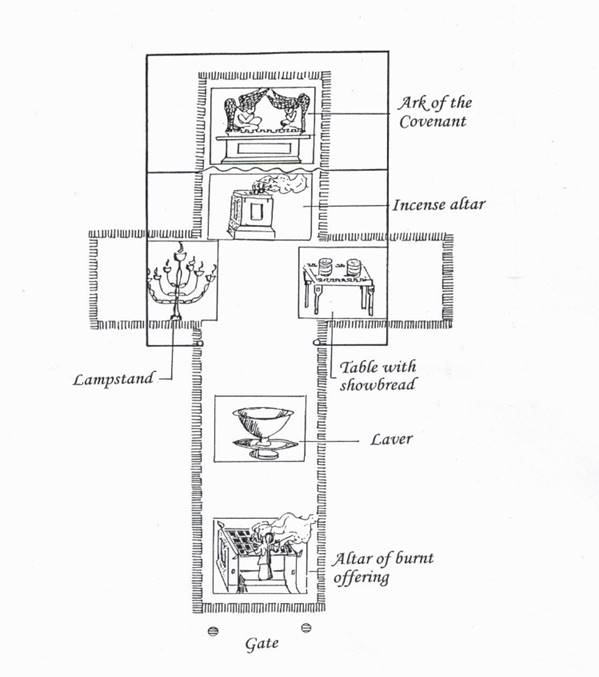
To be able to function successfully as a temple of God, both these perspectives should be fully observed. It is conspicuous that the furniture and equipment in the Old Testament temple were arranged in the shape of a cross, with the vertical and horizontal lines cutting across each other in the Holy Place. The temple thus foreshadowed future things because its symbolism pointed ahead to the future redemptive work of the Messiah on the cross. In the light of this symbolism we can determine how we should function as temples of God.
The man-God-perspective
The first line in this cross represents the man-God-relationship. It starts at the gate, proceeds through the courtyard, and then into the temple right up to the Ark of the Covenant. The gate leading to the courtyard provides an entrance to the Lord’s sanctuaries, and was fulfilled at the coming of the Messiah. He said: “I am the door. If anyone enters by Me, he will be saved” (John 10:9). On entering the court, we first encounter the altar for burnt offering where sacrifices were made for the atoning of people’s sins. All these repetitive sacrifices pointed to Jesus’ once for all sacrifice (John 1:29). “In Him we have redemption through His blood, the forgiveness of sins, according to the riches of His grace” (Eph. 1:7). Further on, we come to the laver where the priests washed their hands after offering the sacrifices, resulting in the water being mixed with blood. That was the proof of a completed sacrifice. After Jesus had died on the cross, water and blood flowed from His side as a sign that He had died and laid down His life for us (John 19:33-34).
As one enters into the Holy Place and walks straight forward one reaches the incense altar. It had an overlay of gold and was used for the burning of incense as a continuous sweet aroma to the Lord. This sweet-smelling aroma symbolised continuous prayer, through which we gain access to the presence of God.
Right at the back of the incense altar was the veil which divided the Holy from the Most Holy Place. Behind the veil, in the Most Holy Place, was the Ark of the Testimony (or Ark of the Covenant), which represents God’s throne of grace. Only the High Priest could enter the Most Holy on the Day of Atonement, to atone for the nation’s sins. The true presence of the Lord was therefore not accessible to the ordinary people and other priests, as they were prohibited from entering the area behind the veil. However, the divide between the Holy and Most Holy was removed by the personal sacrifice of our High Priest, Jesus Christ. We read in Luke 23:45 about the moment when Jesus died on the cross: “Then ... the veil of the temple was torn in two”.
That means that the Old Testament’s sacrificial system and prayers by High Priests were abolished and that every believer is now permitted to enter in before the Lord’s throne of grace through prayer. Paul says: “Therefore, brethren, having boldness to enter the Holiest by the blood of Jesus, by a new and living way which He consecrated for us, through the veil, that is, His flesh, and having a High Priest over the house of God, let us draw near with a true heart in full assurance of faith” (Heb. 10:19-22). Since that moment the need for the temple service has become redundant as the Lord no longer reveals Himself to believers through human mediators – Jesus Christ is our Mediator and High Priest.
All the focal points mentioned above follow a straight line which runs from the gate through the altar for burnt offerings, the laver and the incense altar, to the Ark of the Covenant behind the veil. This line represents the man-God-relationship, and is an illustration of how a person may enter in from the sinful world on the path of salvation which leads to reconciliation with God through the only Saviour of lost humanity. That is the vertical perspective which reaches upwards to the Lord’s throne of grace.
Relations towards fellow humans
The second line in the temple service cuts across the first one which extends from the outer court straight into the Most Holy. This second line extends from the golden lampstand next to the southern wall of the Holy Place towards the northern wall where the tables with the showbread are. The two lines thus form a cross. This second perspective represents the relationship with fellow men in our life of faith. The lampstand refers to the Messiah as the light of the world, and the showbread to Christ as the bread (or sustainer) of life. Through His crucifixion the Lord has, on the vertical level, opened the way to His throne of grace in heaven in order that sinners from everywhere may be forgiven and spiritually regenerated. For that reason, He could stretch out His arms horizontally on the cross to be the light to a dark world and the bread of life to a perishing humanity. It is His express will that both of these perspectives be observed in the lives of His disciples. We should walk according to His ways, experience the continued cleansing by His blood and pray without ceasing, but we must also move out to proclaim Christ to a lost world. All Christians should be witnesses of the Saviour’s grace among a lost humanity, and feed them with the bread of life which is the Word of God. Our love for God therefore has to manifest in our love for our fellow brethren and also for a lost world. Do not only fulfil your own spiritual needs but, through evangelism, also fulfil your command to be the light of the world (Matt. 5:14).
The lampstand in the temple needed continuous maintenance in order to shine brightly without interruption. It had to be refilled with fresh oil daily, lest its lights would start flickering and eventually become extinct. We should also regularly trust the Lord for fresh anointing with the Holy Spirit, thereby anew being endued with power from on high. The big difference between the wise and foolish virgins in the parable of the bridegroom (Matt. 25:1-13), is that the wise virgins took extra oil with them. That refers to the filling of the Holy Spirit – something which the foolish virgins did not experience, and consequently their lamps went out.
Furthermore, the wick of every lamp in die lampstand also had to be regularly cleaned to ensure that it did not start smoking and only yielding a faint light. How much more do we need continuous cleansing by the blood of the Lamb: “Therefore, having these promises, beloved, let us cleanse ourselves from all filthiness of the flesh and spirit, perfecting holiness in the fear of God” (2 Cor. 7:1). That would ensure that we are “blameless and harmless, children of God without fault in the midst of a crooked and perverse generation, among whom [we] shine as lights in the world” (Phil. 2:15). Our spiritual lives therefore have to be maintained daily to prevent us from growing cold in our love by allowing worldliness to gain influence in our lives.
The same principle applies to the table with the showbread. Fresh bread must be served to the hungry, and that demands that we do intensive Bible study to always derive old and new things from the treasury of the Word, and serve it to others. The source is inexhaustible and unsearchable, and therefore demands much commitment to know it and to rightly divide the word of truth in order to correctly explain and apply it under the guidance of the Holy Spirit. At the same time, Bible study should lead to increased personal holiness. It should not merely be an academic exercise in which we only mentally take notice of the Word without changing and enriching us spiritually. We should truly take it to heart and join the psalmist in saying: “Your Word have I hidden in my heart, that I might not sin against You” (Ps. 119:11). “At midnight I will rise and give thanks to You because of Your righteous judgements. I am a companion of all those who fear You, and of those who keep Your precepts” (Ps. 119:62-63). “Direct my steps by Your word, and let no iniquity have dominion over me” (Ps. 119:133).
When the Word is first applied to ourselves to change our own life and make it conformable to the image of God’s Son, then it will more likely be accepted by our hearers as they would desire to have what they can see in our own lives. However, when the light of believers’ testimony only shines faintly, no convincing proof of the power of the Word can be noticed by others.
Holy to the Lord
We are faced by a very big challenge to fulfil our calling to be temples of the Holy Spirit. Remember that this command applies to all believers – not only to a small handful of persons who serve the Lord full time. Every believer is a New Testament temple of the Lord in his or her own right, although corporately as congregations they can also serve the Lord as a temple. To be able to do so all of us have the obligation to live holy lives: “For the temple of God is holy, which temple are you” (1 Cor. 3:17). How does the temple service function in your life? Make sure that both perspectives of it are pursued. In the man-God relationship you must approach the throne of grace through Jesus Christ to be continuously cleansed from all sin by the blood of the Lamb. You also have to frequently engage in intercession for a world in its need. When you do that you will have the boldness to offer yourself to the winning of souls through the proclaiming of the gospel, so they can also be transformed into temples of the living God.
Notice how lamentable are the lives of people who have not yet through rebirth and the filling of the Holy Spirit been transformed into temples of God. They struggle to discover the real sense and meaning of their lives, and then try to make amends for this shortcoming by gathering as much as possible earthly goods. They are mostly confused about religious matters and move from one deception to another. Many of them try to fill the spiritual emptiness in their lives by reverting to Old Testament laws, rituals and feasts, but they do not find true fulfilling in these traditions. The shadowy practices of the old covenant were meant to guide people to Christ for salvation (Gal. 3:24-25).
The discovery must first be made that the sign of the cross in the plan of the temple prophetically points to the Messiah who came in the fullness of time to fulfil the law and the prophets. How wonderful it is that the day will indeed come when the remnant in Israel will look on Him whom they have pierced, and grieve for Him bitterly (Zech. 12:10). Only then will the whole nation who survived the time of Jacob’s trouble, conclude a new covenant with the Lord and no longer serve Him through the mediation of priests and animal sacrifices. They will then by themselves approach the Lord’s throne of grace through the torn veil. It is only by virtue of the atoning death of God’s Son that a person can experience times of refreshing in the presence of the Lord.